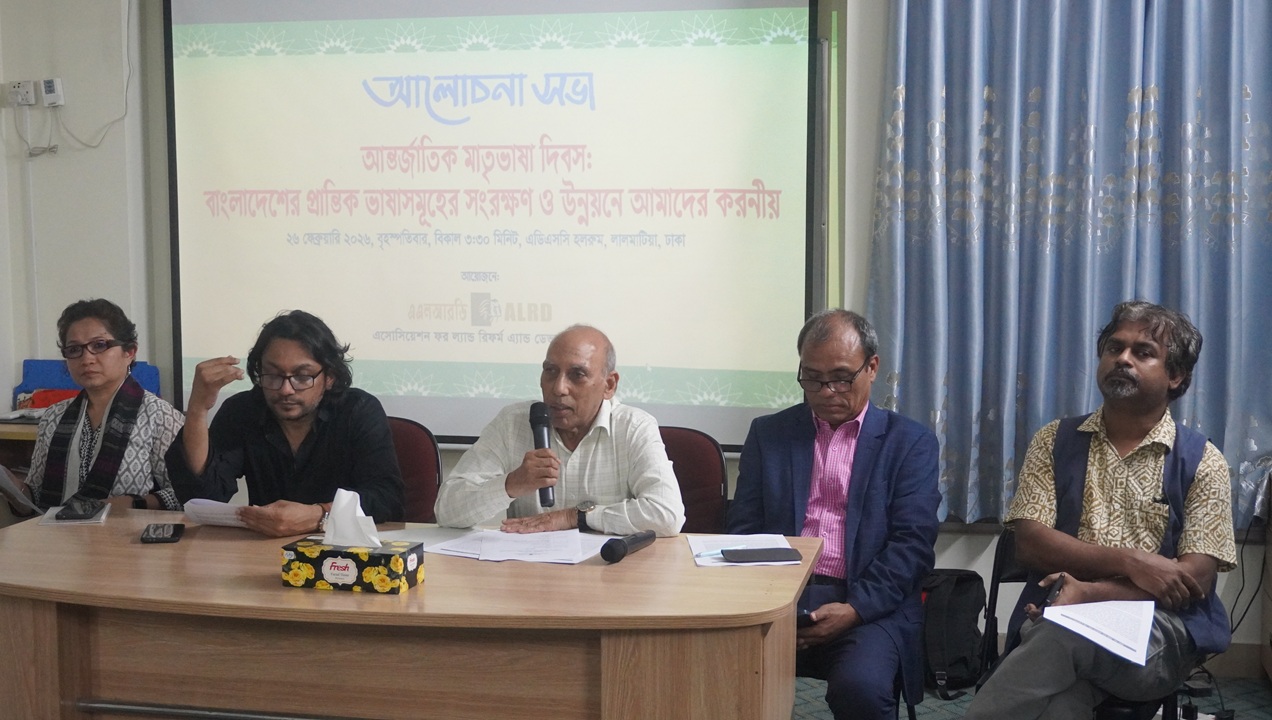
Civil society calls for preservation of languages of marginalized communities
Civil society representatives have urged the government to take concrete steps to preserve the languages of marginalized communities. Speaking at a discussion organized by ALRD on the occasion of International Mother Language Day, they also called on universities to strengthen research on indigenous and minority languages.
The discussion was held on Thursday afternoon, February 26, 2026, at the ADSC Conference Hall in Lalmatia. The session was chaired by ALRD Executive Director Shamsul Huda. Among the speakers were Sanjeev Drong, General Secretary of the Bangladesh Indigenous Forum; Professor Mahmudul Suman of Jahangirnagar University; and Ilira Dewan, Member of the National Human Rights Commission. Development researcher and writer Pavel Partha presented the keynote paper.
In his presentation, Pavel Partha highlighted the growing threat to indigenous languages. He noted that the names of many indigenous villages, markets, and localities are being changed, while the dominance of the Bengali language is gradually eroding indigenous languages. He emphasized that language preservation cannot be separated from the protection of indigenous culture, livelihoods, and social systems. Speaking in one’s mother tongue, he said, is not merely a choice but a core element of identity. In some communities, only a few elderly members still speak their native language, placing many indigenous languages at the brink of extinction. He stressed that preserving the languages of tea garden communities also requires protecting their work environment and cultural context.
Ilira Dewan pointed out that Bangladesh lacks a culture of learning and appreciating its linguistic diversity. As a result, languages of minority communities—apart from the dominant Bengali language—are gradually disappearing. When a language is no longer used, she noted, its loss becomes inevitable.
Professor Mahmudul Suman observed that since the post-colonial period, the state has taken little initiative to preserve indigenous languages and scripts. Academic research on these languages remains limited, with only a few researchers working individually. Expanding university-level research, he suggested, could help document and better understand the current status of marginalized languages.
Sanjeev Drong emphasized that just as the Bengali language is rich with songs, poems, and stories, indigenous communities such as the Santal, Chakma, and Garo also possess rich literary and cultural traditions. However, due to language barriers, these cultural treasures remain largely unknown to Bengali speakers. He noted that the continued neglect of indigenous communities has also meant a lack of meaningful initiatives to protect their languages.
In his concluding remarks, Shamsul Huda said that the global recognition of International Mother Language Day has highlighted the importance of protecting all mother tongues. Yet many indigenous communities in Bangladesh are losing their languages. He urged institutions such as the International Mother Language Institute to take stronger initiatives to safeguard the country’s linguistic diversity.
Media Coverage
Bangla Affairs
The Daily Kalerkantha